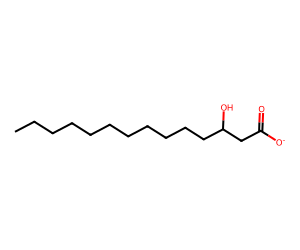
hexanoylglutamine to 3-hydroxymyristate

Numerator Metabolite
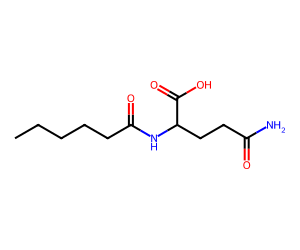
Structure of hexanoylglutamine
Metabolite Accession: GCST90199833
Name: hexanoylglutamine
Hmdb Id: HMDB0242182
Super Pathway: NA
Sub Pathway: NA
Inchikey: NONGMLDQXRDGIT

Denominator Metabolite

Structure of 3-hydroxymyristate
Metabolite Accession: GCST90199674
Name: 3-hydroxymyristate
Hmdb Id: HMDB0061656,HMDB0010731
Super Pathway: NA
Sub Pathway: NA
Inchikey: ATRNZOYKSNPPBF

Associated Genomic Regions

Region: rs2762353

Click a 'Plot' button in the tables to the right to view a locus plot here.

Clumped rQTL variant

Loading Ratio Plot...

Loading Numerator Plot...

Loading Denominator Plot...

SNP Summary

Chr:
6
Beta (Ratio):
-0.338
Position:
25794431
SE (Ratio):
0.015
Effect Allele:
A
Z-score (Ratio):
-22.991
Reference Allele:
G
-log10(P):
-267.650
MAF:
0.441
Beta (Num):
-0.318
Novel Locus:
No
SE (Num):
0.015
Beta (Den):
0.020
SE (Den):
0.015
No CNV overlap
rQTL cluster:
Reaction Distance:
NA

LLM Analysis

Numerator Metabolite Explanation:

Fatty acid metabolism (acyl glutamine)5[1], 6[2]

Denominator Metabolite Explanation:

Fatty acid biosynthesis; Lipopolysaccharide biosynthesis7[1], 8[2]

Ratio Explanation:

The ratio likely reflects a metabolic shift where altered SLC17A4 function impacts urate and thyroid hormone transport, indirectly influencing disparate fatty acid pathways.

Ratio Evidence:

metabolites not in a pathway but enzyme catalyzes one metabolite

Gene Ratio Phenotype Relationship:

Altered SLC17A4 function likely drives changes in serum creatinine and uric acid, key renal function markers.1[1], 9[2] Its role as a thyroid hormone transporter could secondarily affect hematological parameters, as thyroid dysfunction is linked to anemia and abnormal red blood cell indices.10[3], 11[4]

Phenotype Driver:

Gene-centric:SLC17A4

Downloads

Download the full rQTL summary statistics file for this metabolite ratio. Data contains the loci listed here. For each SNP (chromosome, effect_allele, reference_allele, pos_name, position) these columns contain the summary statistics of the ratio (beta, pgain, pval, se, z), the numerator metabolite (beta_1, pval_1, n_iids_1, effect_allele_frequency_1, se_1, z_1) and the denominator metabolite (beta_2, pval_2, n_iids_2, effect_allele_frequency_2, se_2, z_2)

Download rQTL Data