3-hydroxybutyrate to hexanoylglutamine

Numerator Metabolite
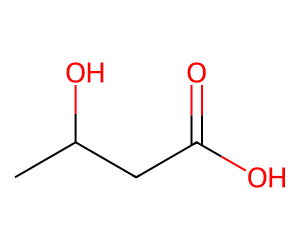
Structure of 3-hydroxybutyrate (bhba)
Metabolite Accession: GCST90200367
Name: 3-hydroxybutyrate (bhba)
Hmdb Id: HMDB0000011
Super Pathway: NA
Sub Pathway: NA
Inchikey: WHBMMWSBFZVSSR

Denominator Metabolite

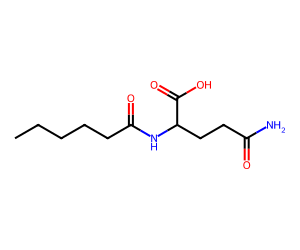
Structure of hexanoylglutamine
Metabolite Accession: GCST90199833
Name: hexanoylglutamine
Hmdb Id: HMDB0242182
Super Pathway: NA
Sub Pathway: NA
Inchikey: NONGMLDQXRDGIT

Associated Genomic Regions

Region: rs77773255

Click a 'Plot' button in the tables to the right to view a locus plot here.

Clumped rQTL variant

Loading Ratio Plot...

Loading Numerator Plot...

Loading Denominator Plot...

SNP Summary

Chr:
1
Beta (Ratio):
0.257
Position:
76217193
SE (Ratio):
0.012
Effect Allele:
A
Z-score (Ratio):
20.632
Reference Allele:
G
-log10(P):
-216.100
MAF:
0.308
Beta (Num):
-0.028
Novel Locus:
No
SE (Num):
0.016
Beta (Den):
-0.285
SE (Den):
0.016
No CNV overlap
rQTL cluster:
Reaction Distance:
NA
Closest Genes:

Region: rs1177442

Click a 'Plot' button in the tables to the right to view a locus plot here.

Clumped rQTL variant

Loading Ratio Plot...

Loading Numerator Plot...

Loading Denominator Plot...

SNP Summary

Chr:
6
Beta (Ratio):
0.313
Position:
25809069
SE (Ratio):
0.012
Effect Allele:
A
Z-score (Ratio):
26.878
Reference Allele:
G
-log10(P):
-364.729
MAF:
0.444
Beta (Num):
-0.004
Novel Locus:
No
SE (Num):
0.015
Beta (Den):
-0.318
SE (Den):
0.015
No CNV overlap
rQTL cluster:
Reaction Distance:
NA

LLM Analysis

Numerator Metabolite Explanation:

Numerator Pathway(s) for 3-hydroxybutyrate are ketone body metabolism and fatty acid oxidation.4[1]

Denominator Metabolite Explanation:

Denominator Pathway(s) for hexanoylglutamine is fatty acid metabolism, specifically the conjugation of hexanoyl-CoA with glutamine.

Ratio Explanation:

Ratio Interpretation: An elevated ratio of 3-hydroxybutyrate to hexanoylglutamine may indicate a disruption in fatty acid oxidation, where a block in the pathway (e.g., due to reduced ACADM function) could lead to increased ketone body production and altered conjugation of fatty acid intermediates.

Ratio Evidence:

Ratio Evidence Level is 'metabolites not in a pathway but enzyme catalyzes one metabolite'.

Gene Ratio Phenotype Relationship:

Ratio-Phenotype Link: Reduced ACADM activity impairs fatty acid oxidation, leading to energy deficiency and accumulation of toxic metabolites.5[1], 6[2] This can impact rapidly dividing cells like hematopoietic precursors, potentially explaining the observed associations with red blood cell indices (MCH, MCHC, Hb, Ht) and other metabolic markers like creatinine and uric acid.

Phenotype Driver:

Primary driver of phenotype link is 'Gene-centric:ACADM'.

Downloads

Download the full rQTL summary statistics file for this metabolite ratio. Data contains the loci listed here. For each SNP (chromosome, effect_allele, reference_allele, pos_name, position) these columns contain the summary statistics of the ratio (beta, pgain, pval, se, z), the numerator metabolite (beta_1, pval_1, n_iids_1, effect_allele_frequency_1, se_1, z_1) and the denominator metabolite (beta_2, pval_2, n_iids_2, effect_allele_frequency_2, se_2, z_2)

Download rQTL Data